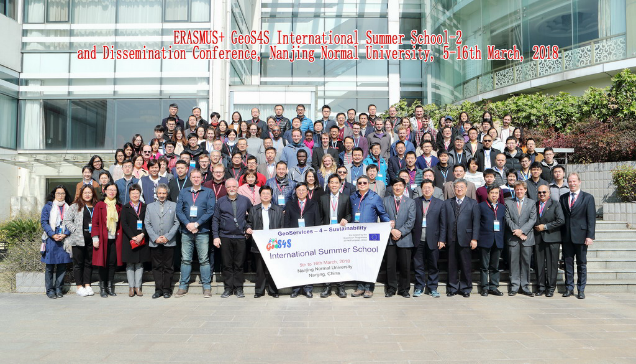
The European Union ERASMUS+ GeoS4S (GeoServices-4-Sustainability) International Cooperation Symposium on Graduate Training in GIS was held in Nanjing on March 10-11, 2018. College of Geospatial Information Science and Technology (CGIST) was invited to the Symposium and had an exchange on talent training of GIS.
The European Union Erasmus+GeoS4S is one of the key projects on international university cooperation and teaching improvement. It was established by the Education, Audiovisual and Culture Executive Agency, European Union in 2015. The project is undertaken by 10 universities and colleges from Austria, Germany, Netherlands, Czech Republic, Thailand and China. It plans to develop 20 courses in the field of GIS and applied fields. Through the form of online courses, it aims to explore the reform of teaching mode and the improvement of teaching level, and train excellent talents have vision of international horizons.
During the Symposium, the project institution provided a report about ten courses, which includes application of real time geospatial space, digital terrain analysis, geo-visualization, disaster management and sustainable development and smart cities. CGIST was invited to give a report on the training of the GIS talents of Capital Normal University (CNU). CGIST teacher introduced the development concept of high-level personnel training with high-level of scientific research in CNU, and from the internationalization of the teacher team construction, the reform of teaching mode, the ability of students to practice innovation, criticism and many aspects. These respects focus on improving the quality of personnel training, and have consistently achieved outstanding results in students rates of advanced studies and various competitions. The distinctive talent characteristics of CGIST have attracted wide attention in the Symposium.
The Symposium was held by the Education, Audiovisual and Culture Executive Agency, European Union, and undertaken by Nanjing Normal University. Teachers and students representatives from Germany, Austria, Netherlands, Czech Republic, Thailand and 30 domestic universities attended the Symposium.
--Wang Tao, Zhang Xizhen