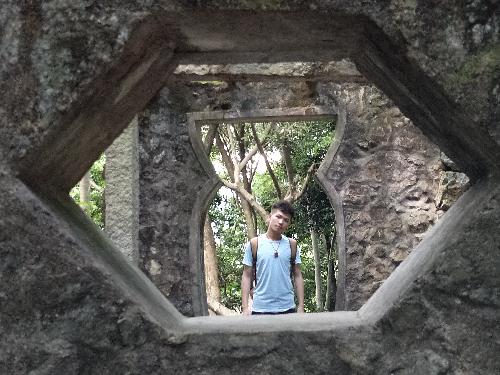
Self-intro
Xu Ronglong, a 2017 student of the College of Geospatial Information Science and Technology, Capital Normal University, majoring in remote sensing of 2017. This student has good professional quality and scientific research potential. He not only ranked first in his major, but also won the first-class scholarship for two consecutive years. In addition, there are the third prize of the National College Student Mathematics Competition, the first prize of the Beijing College Student Mathematics Competition, the third prize of the American College Student Mathematical Contest in Modeling, and other honors. He has participated in five scientific research work, has six internship experiences, and published Two papers, one of which was published in the internationally renowned journal IEEE-JSTARS as the first author. This year, he obtained admission intentions or offers from Tsinghua University, Sun Yat-sen University, Institute of Geography, Chinese Academy of Sciences, Nanjing University, Tongji University and other prestigious universities, and successfully obtained one of the eight re-examination qualifications of Peking University, now he has been pre-admitted by WestLake University and is about to study for a doctorate.
Take root in the profession and focus on ability training
Xu Ronglong's mathematics ability is relatively strong. During his time in school, he ranked first in the college in advanced mathematics, linear algebra, and probability theory. CET 6 reading is close to full marks. He has used 15 hours to read 77.6k original English works, plus a lot of literature reading, all of which are helpful to his English improvement. In order to improve his English level, he prepares IELTS every day for listening, speaking, reading and writing, and learns to apply English in participating in American college student math competitions, academic essay writing and usual training.
Contribute to the environment
Because he has been very concerned about environmental destruction and resource waste since he was a child, and he hopes to make a little contribution to improving the environment and saving resources in the future, so he especially hopes to be able to engage in research related to environmental and ecological remote sensing in the future, which also prompted him to start His first scientific research. After a year and a half of hard work, he completed his own independent research-"A simple phenology-based vegetation index for mapping invasive Spartina alterniflora using Google Earth Engine". He has now completed the article as the first author and published it in the journal "IEEE-Jstarts", the journal's impact factor is 3.827.
This article was a huge challenge for him. It took him a year and a half. From June to August 19, he was initially exposed to scientific research, learning basic skills, such as code, reading literature, and so on. The formal experiment began in August 19 and lasted for more than half a year. During this period, in order to solve the problem, he proposed many sets of plans, each set of plans will derive a series of problems, some of which may take two or three days, and then try more than a dozen solutions before they can be resolved. So, this process is particularly long and painful.
What impressed him the most was that almost everything is unknown. Any problem must be solved as soon as possible. Sometimes it takes him a long time for a problem, and after trying many solutions, he will not be able to do it. Feeling particularly stressed. But in the end, he persisted little by little with his perseverance. He was very careful about every link in the scientific research process. For example, he wrote a total of 113 codes for data processing, exported more than 3000 pieces of data for data analysis, and wrote more than 60 when editing the paper. Different versions finally form a complete manuscript.
However, he also learned a lot of skills in this process, and he also understood the respect of scientific research and the seriousness of academic responsibility. He decided to make achievements in the environmental field in the future.
Pass on warmth
Along the way, he is particularly grateful for the good environment provided by the school and college for him to exercise and show himself. He also thanked all the teachers and classmates who helped him, especially the enlightenment from Lou Shuhan's. These gathered together, and he has today's results. He always remembered it in his heart and worked hard to pass on this warmth, so he participated in the conversation with the freshmen and actively imparted his experience, hoping to sow the seeds of dreams for the younger students.
He is striving to become a qualified scientific researcher, always regards excellence as his code of conduct, and decides to fight for his ideals for life.
